Wine Film Review – Corked
The 2009
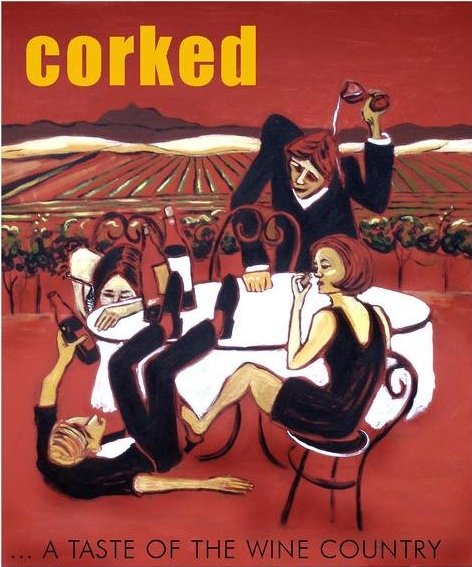
comedy/”mockumentary” Corked looked at
the popularity, stereotypes, and occasional instances of pretentiousness of the
Northern California wine country. In particular, the movie looked at four
entirely different wine producers during the harvest Season in Sonoma,
California. At the onset, the movie explained the definition behind its title and noted that “corked” is defined as “having
an unpleasant odor and taste (as from a tainted cork).
This introduces viewers to a
new side of “corked” wine. Most wine drinkers are likely familiar with a
“corked wine,” but may not know really what a corked wine tastes like or how to
detect a corked wine. A “corked” is a term for a wine
that has become contaminated with “cork taint.” This is caused by the presence
of a chemical compound, TCA (2, 4, 6, - trichloroanisole). This occurs when natural fungi inside the cork comes in contact with
chlorides found in bleaches and winery sterilization products. TCA is not just
limited to one single batch of corks – but can in fact infect an entire cellary
or winery. This causes an unpleasant taste to the wine, but is not harmful to humans. Common taste descriptors include damp, soggy, or rotten
cardboard. The incidence of tainted corks has also given rise to the popularity
of screw caps and other alternative methods of closures for wine bottles. Any
consumer who purchases a “corked” wine should return it to the store from which
it was purchased or send the wine back at a restaurant.
Throughout the movie, the
documentary crew interviewed a wide range of people and tourists in the wine
industry. The crew got a taste of a great variety of personalities,
involvement, and intelligence about the wine industry. The movie opened with its
first vineyard and with its first comedic jab at the Moreno Russo Estates in
Sonoma County, California. The documentary crew was giving a tour of the estate
– despite the hesitations of the tour guide to go on such an adventure without
a script. At Moreno Russo, they prided themselves on tradition and
progressiveness, along with providing good wine and an attitude that spoke to
the best people. The attitude was of utmost importance – it let some people
know that they were accepted and could drink their wines, while letting others
know that “frankly, they could be better off in the lower sections of the
isle.”
Turns out this man giving
the tour was Donald Smythe, the Ambassador of Wine for Moreno Russo Estates. He
was easily the funniest, and most pretentious, out of all the winemakers. He
thought “horticulture – the underdogs were trying to come through here, but he
did not think that’s what America was about.” He believed quality was important
for the people who could appreciate it. During the harvest time,
Donald believed the real backbone of the vineyard aside from himself was the
vineyard workers. Harvest time actually seemed like a calm time for
Donald, while everyone around him worked extremely hard. Donald’s demeanor and lack
of effort is in contrast to what we have been introduced to in class in terms
of the wine making process. We have learned that this is a very labor
intensive, hands on process in which most vineyard owners and workers are
heavily involved in a hands-on manner during the harvesting season.

The film, however, did take
a turn into a more familiar work-ethic direction with the introduction of Gerry
Hannon, the owner/winemaker of Hannon Winery. He used to play Frisbee golf, jet
ski, and go fishing, 8 years ago. Clearly, his vineyard has taken up all of his
time and become the sole focus in his life – it is most certainly a “one-man”
Gerry show. Gerry was shown dumping a large create of grapes to be de-stemmed
and crushed. Gerry loved being his own boss – he was the winemaker, cellar master,
vineyard manager, and eventually the hospitality host (if he ever got a tasting
room). It was evident Gerry was a hardworking man, possibly overwhelmed, but
still hardworking. His hands are part of the entire process. Gerry seemed like
he was really working around the clock. The crew caught him dozing off numerous
times during the day while harvesting the grapes.

Gerry seems like a perfect
example of what it takes to run a vineyard. Gerry is completely involved in
every step of the process, and it is very obvious how labor and time intensive
the wine-making process is for an individual. Gerry has devoted his entire life
to making wine – and that seems to be exactly what it takes to be successful in
this industry.

The crew also met Scott and
Gary, the marketing entrepreneurs of ScoGar LLP. They had never travelled up to
the Sonoma County wine country. Apparently, it was not their “job.” Scott and
Gary “bought” their wines essentially at a fax and copy machine station. They
placed orders and put together promotional orders. Turns out, they did not
drink a lot of wine either. Gary was more apt to drink Vodka, and thought wine was
best for dessert. Scott was sober (A.A. for 10 years). He believed he did not need
to drink wine to sell wine. Scott and Gary came up with a new marketing
campaign dedicated to the hip-hop generation. This was the “Shizzle Creek”
campaign. Scott and Gary, however, ran into some trouble. The Bureau of Alcoholic
Beverage Control revoked their label because of this campaign. This was done
because it was brought to their attention that some people might find the
content of their label offensive. Eventually, the duo moved past “Shizzle
Creek” and went with the label name “Anarchy.”
Scott and Gary are clearly
terrible examples of what it takes to be in the wine marketing business. They
needed to get out there and see Sonoma County and get involved and taste the
wines. I don’t think they can truly “sell” wines without experiencing the
wines. They need more “hands-on” experience with wine, which is something that
has truly been advocated in this class throughout the semester. It is a
learning process and Scott and Gary need to dive in and really learn more about
the wines in order to be able to sell them.
The documentary crew
additionally spoke with the new owner of Pena Cellars, Eli Tucker, super CEO! Eli was so
excited about the image of owning a winery – especially concerning how the
women would view him and how women would respond to this acquisition. Before
becoming CEO, Eli was all about “finding himself” – he was on a spiritual quest,
parting and going to clubs, exploring foods. He ended up in the wine country
because of his dad – who was a billionaire – and took over a winery. His dad,
Jim Tucker, Texas billionaire, saw this as a last ditch effort to retrieve his
son from ineptitude. Eli thought the cellar's wine labels looked old
and boring and wanted to change the labels to something more modernized and
spiced up.
As pointed out to him, Eli did not understand how long it took to
build up a wine-making reputation and rise to an excellent quality status in
the wine industry. Eli was clearly on track to
run the vineyard into the ground. Eli, like Scott and Gary, prove to be
examples of individuals who truly knew nothing about the wine industry and
might have not been in the best positions suited for their talents and skills.
Also from Pena Cellars, the
crew met up with Dane Phillips, the vineyard manager. Dane was happy to show off his 750 mega blaster, his pet project. This
project sent out 120 decibels of sound over 30 acres and took care of every
bird problem he had. The sound was piercing, hilariously piercing and annoying.
The deer problem was taken care of by a “cougar” sound from this device, too. Aside from this sound blaster, Dane did
nothing all day but run, pick up grapes, sample grapes, check their sugar
content, and make sure they are ready for picking. He also noted the enamel
from his teeth was gone at the end of the day because of all the acid from the
grapes. Dane’s heart was clearly in the right place, and his dedication to the
wine industry was unequivocal.

As the movie progressed, Dane
invited tourists Norma and Larry to pick grapes during the harvest. Norma and
Larry were absolutely thrilled and exciting to be picking grapes, though ultimately
they truly desired to stomp the grapes. Picking the grapes from the vine turned
out to be a little faster paced than they anticipated. The duo proved to be too
slow. Overall, the day was not the “walk in the park” that they expected. Norma
totally ruined her sandals. Larry seemed to gained a new appreciation for the
process of making wine.
I think Norma and Larry’s
experience is indicative of the hard work related to the wine-making process,
as detailed in class. I think Norma and Larry are perfect examples of how
regular tourists do not exactly realize how intense and thorough the
wine-making process is until they get out there and see how the process goes
along. I am really glad Larry gained a new appreciation for the wine-making
process. I think this was a great educational, “a-ha!” moment for the couple.
The documentary crew lastly mentioned of Richard Parsons, a wine critic and editor of Wine
Aristocrat. Donald deemed him as a “demigod.” Parsons apparently was going to
be in attendance for the upcoming 34th annual “Golden Harvest”
awards ceremony. Every winemaker was trying to make sure he ended up tasting
his or her wines. At the ceremony, Moreno Russo estates went home with the Golden Cluster award. As it turned out, however, Moreno Russo, and Donald, cheated, as exposed in Wine Aristocrat. The award was given to Hannon Winery.
I would cautiously recommend
this movie to other wine drinkers, especially if they are looking for a laugh.
It might not be the best movie for someone of a more serious mindset, but I
enjoyed it. Any individual educated on the wine industry will know what is
closer to the truth in this movie and be able to separate it from the humorous,
“mockumentary” style moments. I definitely go for this kind of dry, sarcastic
humor. I also loved/hated Donald Smythe. He was adorably annoying. It might not
have been the most educational wine film, but it was a nice, lighter take on
the wine world in California. It was also a nice compare-contrast between the
hard-working wine growers whose entire lives were invested in the wine process,
to other CEOs and Ambassadors who seemed to live a more distanced, cushiony
life in the wine industry. There are some moments of truth, amongst the many, many
moments of pretentious, ridiculous decisions and actions. Also, in the end, Hannon Winery came out on top with the Golden Cluster award. It made everything in the movie feel much better to me. The hard working Gerry Hannon came out on top, while Donald Smythe had his trophy taken from him.
Sources – Information:
Sources – Pictures:



/300px-Corked!_(Trailer).jpg)
